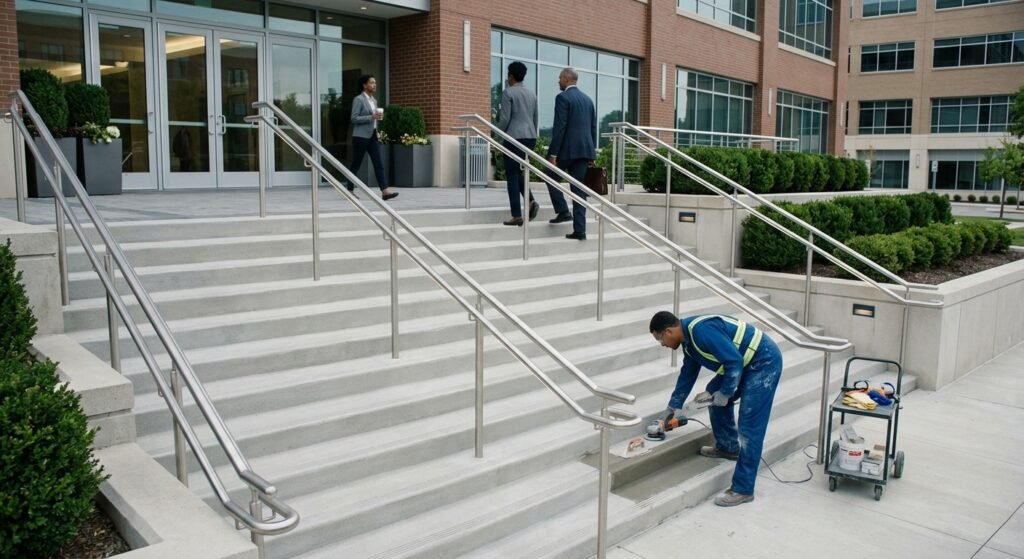
Why Concrete Steps Restoration Reduces Liability Risks | Commercial Property Owners
Every commercial property owner faces a hidden threat lurking in plain sight: deteriorating concrete steps. Consequently, cracked treads, uneven risers, and crumbling edges don’t just look unprofessional; they create serious safety hazards. As a result, these hazards expose property owners to costly lawsuits, insurance claims, and reputational damage. Therefore, understanding why concrete steps restoration matters isn’t just a maintenance decision; it’s a liability management strategy.
The Real Cost of Neglected Concrete Steps
First, let’s address the obvious risk: slip-and-fall accidents. Indeed, damaged concrete steps rank among the leading causes of premises liability claims across commercial properties. Specifically, uneven surfaces, missing chunks of concrete, and worn nosing edges cause tenants, customers, and visitors to lose their footing. Meanwhile, business owners often underestimate how quickly minor cracks escalate into major hazards.
Additionally, weather conditions accelerate this deterioration. For instance, freeze-thaw cycles force water into small cracks, then expand and contract the concrete repeatedly. Over time, this process widens cracks, breaks apart edges, and creates trip hazards that weren’t there the previous season. Similarly, de-icing salts corrode concrete surfaces, weakening the structural integrity of steps used daily by dozens or hundreds of people.
How Concrete Steps Restoration Reduces Liability Exposure
So, how exactly does restoration protect property owners? Primarily, it eliminates the physical hazards that cause accidents in the first place. Furthermore, restoration addresses root causes rather than surface symptoms, meaning the repair lasts far longer than a quick patch job.
1. Eliminates Trip-and-Fall Hazards
Above all, restoring cracked, chipped, or uneven steps removes the exact conditions that trigger falls. Consequently, fewer accidents mean fewer claims, and fewer claims mean lower legal exposure. Moreover, professional restoration corrects riser height inconsistencies, which building codes specifically regulate because uneven risers disrupt a person’s natural walking rhythm.
2. Demonstrates Reasonable Care
In premises liability law, courts often examine whether a property owner exercised “reasonable care” in maintaining safe conditions. Therefore, documented, regular concrete steps restoration serves as tangible proof that you took proactive steps to prevent injury. In contrast, ignoring visible damage can be interpreted as negligence, especially if an accident occurs on a step that was already showing clear signs of deterioration.
3. Supports Compliance with ADA and Building Codes
Similarly, restoration work provides an opportunity to bring steps into compliance with the Americans with Disabilities Act (ADA) and local building codes. Specifically, contractors can correct improper slopes, add or repair handrails, and install compliant tread depths during the restoration process. As a result, compliance reduces the risk of code-violation citations alongside injury-related claims.
4. Improves Visibility and Traction
Additionally, restoration allows property owners to add slip-resistant coatings, high-visibility edge striping, and proper drainage solutions. Thus, even in rain or snow, steps remain safer and more visible. Ultimately, these upgrades address multiple risk factors simultaneously rather than treating safety as an afterthought.
5. Protects Insurance Standing
Meanwhile, insurance carriers increasingly scrutinize maintenance records when processing premises liability claims. Consequently, a documented restoration history can support your defense and potentially prevent premium increases after an incident. On the other hand, a history of ignored maintenance requests or unresolved complaints can work against you during litigation.
Warning Signs That Signal Immediate Restoration Needs
Before problems escalate, watch for these red flags:
- Visible cracks wider than a quarter-inch
- Spalling or flaking concrete surfaces
- Uneven or crumbling step edges
- Pooling water on step surfaces
- Loose or missing handrails
- Noticeable height differences between risers
If any of these signs appear, prompt action becomes essential. After all, waiting until an accident occurs is far more expensive than addressing the issue proactively.
Why Proactive Maintenance Beats Reactive Repairs
Ultimately, reactive repairs after an incident cost significantly more than proactive restoration. Beyond legal settlements, property owners often face increased insurance premiums, tenant turnover, and reputational harm that lingers long after the physical repair is complete. Conversely, scheduling routine inspections and addressing minor damage early prevents small cracks from becoming five-figure liability claims.
Furthermore, regular restoration extends the lifespan of your concrete investment. Rather than replacing entire staircases, targeted restoration techniques such as resurfacing, crack injection, and edge repair restore structural integrity at a fraction of full replacement costs. Therefore, restoration protects both your budget and your legal standing simultaneously.
A Practical Approach | Taking Action
To minimize liability risk effectively, property owners should:
- Schedule seasonal inspections, particularly after winter freeze-thaw cycles.
- Document all maintenance and repair activities in writing.
- Address minor cracks immediately rather than deferring repairs.
- Partner with licensed, insured concrete restoration contractors.
- Confirm ADA and local code compliance during every restoration project.
By following these steps, property owners create a defensible safety record while genuinely protecting the people who use their property daily.
Frequently Asked Questions (FAQs)
Q: How often should commercial concrete steps be inspected?
A: Ideally, inspections should occur at least twice a year once before winter and once after since freeze-thaw cycles cause the most damage. However, high-traffic properties benefit from quarterly inspections instead.
Q: Can concrete steps restoration really prevent lawsuits?
A: While no maintenance program eliminates all risk, documented restoration significantly reduces the likelihood of accidents and strengthens your legal defense if a claim does arise. Essentially, it demonstrates reasonable care and proactive risk management.
Q: What’s the difference between concrete repair and full restoration?
A: Repair typically addresses isolated damage, whereas restoration takes a comprehensive approach, correcting structural issues, improving slip resistance, and ensuring code compliance across the entire step structure.
Q: Does concrete steps restoration affect insurance premiums?
A: Yes, often positively. Insurers frequently view documented maintenance records favorably, and some carriers offer reduced premiums for properties with proactive safety programs in place.
Q: How long does concrete steps restoration typically take?
A: Most commercial concrete steps restoration projects take one to three days, depending on the extent of damage. Consequently, disruption to tenants or customers remains minimal compared to full replacement.
Q: Is concrete steps restoration required for ADA compliance?
A: Not always, but restoration provides a natural opportunity to correct non-compliant slopes, handrails, or tread dimensions, reducing the risk of code violations alongside injury claims.